
How to Search Cleveland County Court Records
Cleveland County court records now start with the North Carolina eCourts Portal for many public online searches. Cleveland County went live in eCourts on October 13, 2025, as part of the final Track 10 rollout. The Portal can show case information, hearing data, public documents when available, and payment options for eligible fines and fees. It is the best first stop when a user has a party name, attorney name, case number, or citation number.
Online search is not the only access channel. The Clerk of Superior Court remains the local file custodian for Cleveland County court records. Public terminals at clerk offices can be used for civil, criminal, estates, and special proceeding searches. Paper files, certified copies, full older files, and background checks should be routed to the clerk rather than to a state administrative public-record request form.
- Open the North Carolina eCourts Portal and choose the search path that fits the record.
- Search by case number when known. For traffic cases, use the citation number if the ticket lists one.
- Use Cleveland County as the location filter when the Portal offers county or court filtering.
- Review the case number, parties, case type, status, hearing dates, and payment fields shown in the result.
- Contact the Clerk of Superior Court for full file review, certified copies, older paper files, or records that do not appear online.
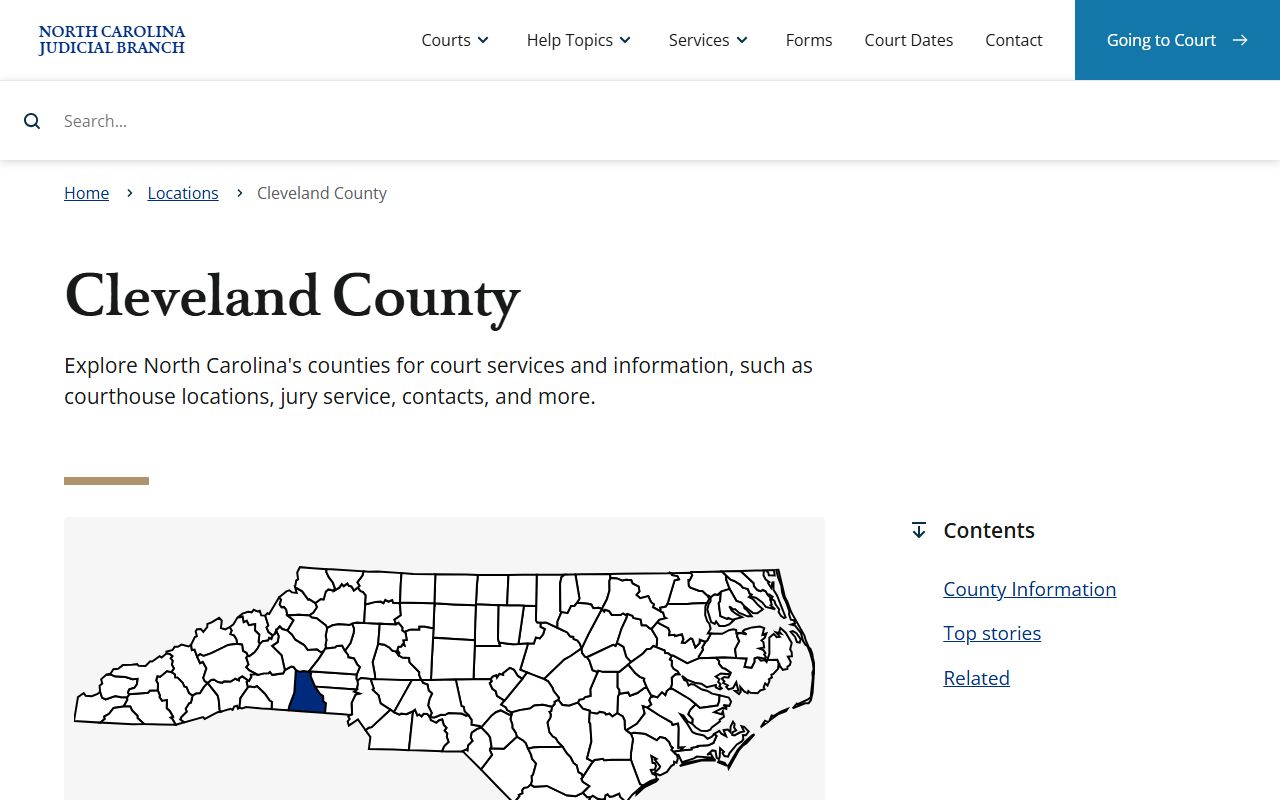
The Judicial Branch Cleveland County landing page is the source for local court links, district information, calendars, payments, and service pages. The Cleveland County Judicial Branch page shows how court services are grouped for the county.
Cleveland County Court Records Search Fields
The eCourts search fields matter because Cleveland County names are not unique across North Carolina. A common last name can return cases from many counties unless the user narrows the search. Exact case numbers and citation numbers tend to be cleaner than broad name searches, but name searches are still useful when the case number is not known.
| Field Label | Type | Required | Options / Format Notes |
|---|---|---|---|
| Smart Search | Text | No | Searches by case number, party name, attorney, citation, and related terms. |
| Case Number | Text | No | Best when copied exactly from court paperwork or a prior Portal result. |
| Name / Party | Text | No | Use last name and first name; try business-name variations where needed. |
| Attorney | Text | No | Useful when counsel of record is known and party names are broad. |
| Citation | Text | No | Most useful for traffic and infraction records. |
| County / Location | Filter | Recommended | Select Cleveland County to reduce statewide false matches. |
| Date Range | Date | No | Narrows filed dates or hearing dates when the interface exposes the field. |
Portal results should be read as a public case index first. If the result points to a paper file, sealed matter, or document that is not available to the public online, the next step is the clerk counter or a public terminal at the courthouse.
Cleveland County Courthouse Contact
The active courthouse for Cleveland County Court records is in Shelby on the justice campus. That address is separate from the historic courthouse on the square, which is now associated with the Earl Scruggs Center and local history. Court hearings, clerk counter service, cashier payments, and most trial court record access are tied to the active courthouse.
Cleveland County Courthouse
100 Justice Place
Shelby, NC 28150
(704) 476-7800
Monday-Friday, 8:30 a.m. to 5:00 p.m.
Clerk of Superior Court
100 Justice Place
Shelby, NC 28150
(704) 476-7800
Court files, copies, estates, terminals, and payments
Magistrate
Cleveland County courthouse area
Shelby, NC
(704) 476-7819
After hours: (704) 480-2892
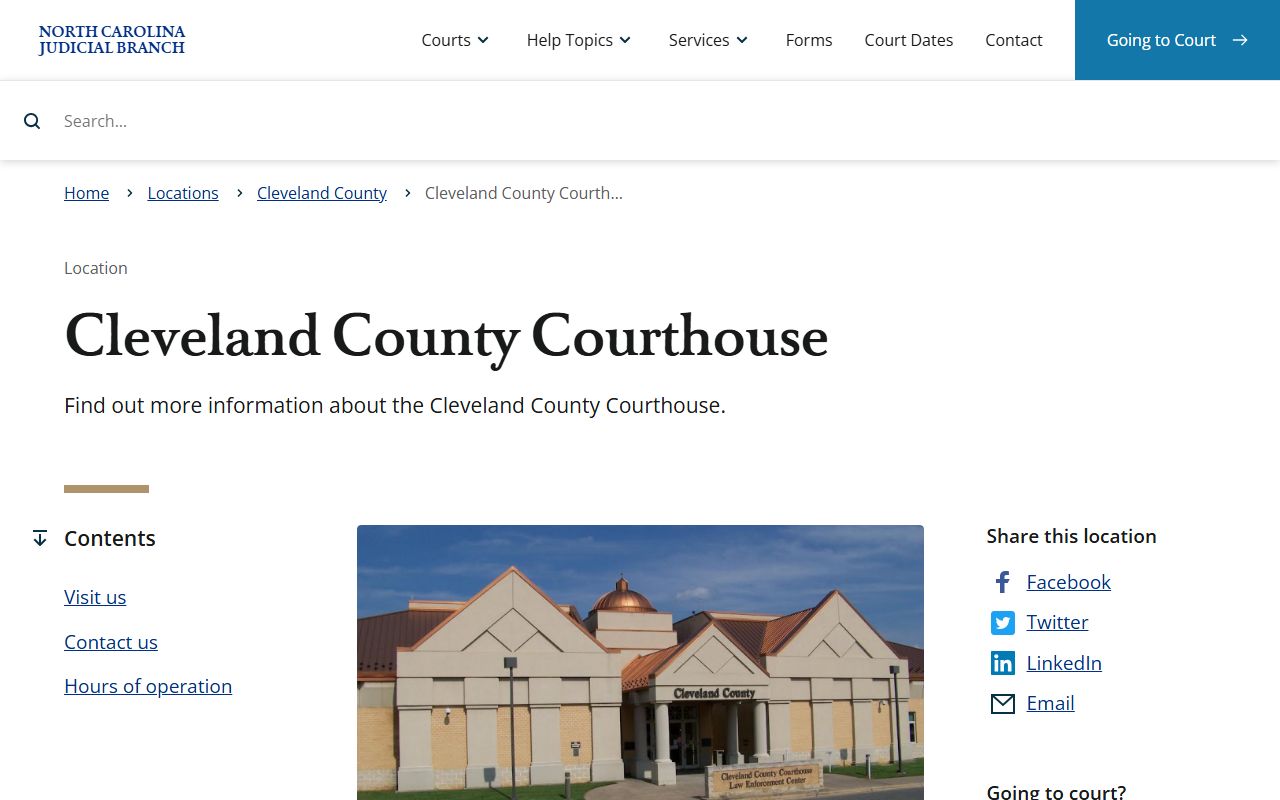
The official Cleveland County Courthouse page confirms the address, public hours, and main phone number for Cleveland County court records service.
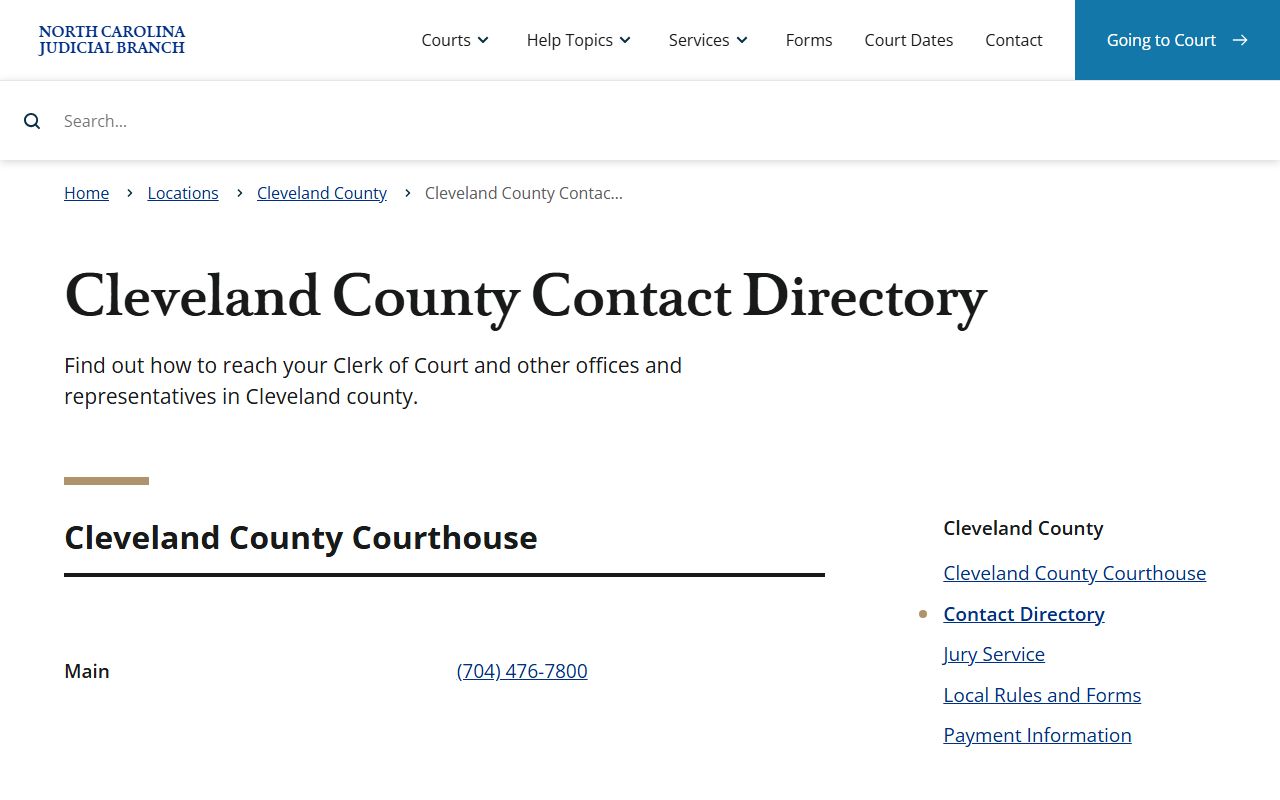
The Judicial Branch contact directory is the source for clerk, judge, magistrate, district attorney, child support, and guardian ad litem phone routing. The Cleveland County contact directory helps court records users choose the right court office before calling.
Cleveland County Court Structure
Cleveland County is part of the North Carolina General Court of Justice. The local trial court work is split between Superior Court and District Court, both operating within District 39 structures listed by the Judicial Branch. The Clerk of Superior Court is not just an office counter. In North Carolina, the elected clerk maintains court files and also acts as probate judge for many estates and special proceedings.
Municipal police agencies may issue citations or make arrests in Shelby, Kings Mountain, Boiling Springs, and other towns, but state criminal and traffic cases route into the same trial court system. Cleveland County does not have county courts at law or justice-of-peace courts of record like some other states.
| Court or Office | Role | Main Record Relevance |
|---|---|---|
| Superior Court | General-jurisdiction trial division | Felonies, higher civil cases, jury trials, appeals from District Court, and some special proceedings. |
| District Court | Trial division for lower and specialized matters | Misdemeanors, traffic, infractions, domestic, juvenile, small claims, and lower civil matters. |
| Clerk of Superior Court | Record custodian and probate judge | Case files, dockets, copies, estates, liens, judgments, terminals, and special proceedings. |
| Magistrate | Initial judicial officer | Warrants, initial appearances, bonds, small claims functions, and marriages. |
The state court structure page explains the Appellate Division, Superior Court Division, and District Court Division. The North Carolina court structure overview is the statewide frame for Cleveland County court records.
Cleveland County Court Type Comparison
The difference between Superior Court, District Court, the clerk, and the Register of Deeds prevents many wrong-office requests. Court case files are not the same as land records, marriage certificates, jail bookings, or state driver records. The table below keeps the common record routes separate.
| Record Need | Primary Office | Where to Start |
|---|---|---|
| Felony case or major civil case | Superior Court / Clerk | eCourts Portal, clerk terminal, or Clerk of Superior Court. |
| Misdemeanor, traffic, domestic, juvenile, small claims | District Court / Clerk | eCourts Portal, court-date search, or clerk office. |
| Estate, will, guardianship, special proceeding | Clerk of Superior Court | Probate counter, public terminal, Guide & File where available. |
| Marriage license or certified marriage certificate | Register of Deeds | Register office, online marriage application, or state vital records channel. |
| Current jail custody or inmate detail | Sheriff's Office | P2C Inmate Inquiry or Cleveland County NC Sheriff app. |
The Judicial Branch types-of-courts page gives more detail on North Carolina trial and appellate courts. The types of courts overview helps explain why the same courthouse can hold more than one type of record.
Cleveland County Court Record Types
Cleveland County court records include civil actions, criminal cases, traffic and infraction records, estates, special proceedings, family matters, judgments, liens, and small claims records. A criminal court file tracks prosecution and disposition. A jail booking record tracks custody. A traffic court record tracks citation handling through court. A DMV driver record tracks license status and points through the driver agency.
Family and domestic records can include divorce, custody, child support, equitable distribution, and domestic violence matters. Estate records can include wills, letters, inventories, accountings, creditor notices, and orders. Juvenile, adoption, mental health, sealed, and expunged files are not ordinary public records and may be unavailable online.
Cleveland County local rules and forms are a useful source when a case requires county-specific procedure or local filing material. The Cleveland County local rules and forms page points court records users to local court materials.
Cleveland County Court Records Access Law
North Carolina public access for Cleveland County court records depends on both the general public-records law and the more specific law for clerk-held court files. The public-records request route is useful for existing Judicial Branch administrative records, but the state warns that NCAOC is not the custodian for local case documents, background searches, marriage certificates, or vital records. For a case file, the local clerk is the practical custodian.
Key North Carolina statutes:
G.S. 132-1 defines public records broadly for North Carolina agencies.
G.S. 7A-109 makes clerk-maintained court records open to public inspection during regular hours unless another law blocks access.
G.S. 15A-145.5 provides an expunction path for certain nonviolent misdemeanors and felonies.
G.S. 7B-3000 treats juvenile court records as specially maintained and not open like ordinary adult case files.
The Judicial Branch public-record request form is still important for records held by the branch as an agency. The Judicial Branch public-record request page explains the custodian limits that apply before a user submits a request.
Restricted Cleveland County Court Records
Some Cleveland County court records are not available through normal public search. Juvenile delinquency and abuse, neglect, or dependency files are controlled by Chapter 7B. Adoption records are confidential. Involuntary commitment and mental health files include sensitive medical and liberty information. Sealed and expunged criminal records may be hidden by court order or statute.
Redactions are also common in otherwise public files. Social Security numbers, financial account numbers, protected addresses, minor names, sensitive victim details, and some domestic violence information may be removed from public copies. When an online result is missing, the reason may be legal restriction, not a system error.
Cleveland County Court Payment Rules
Cleveland County payment rules vary by record and case type. Traffic citations, fines, fees, and court costs may be payable online when eligible, in person at the courthouse cashier, or by mail. The research file did not identify a local court-copy fee schedule separate from the statewide court-costs publication, so exact court-copy amounts should be confirmed with the clerk before ordering.
| Payment or Fee Item | Amount or Rule |
|---|---|
| Mail payment for eligible court/traffic matters | Money order or certified check only; no cash or personal checks; include citation number where applicable. |
| In-person payment | Cash, credit/debit card with processing fees, money order, or certified check; no personal checks. |
| Online eligible payment | Credit/debit card with processing fees through official Judicial Branch services. |
| Certified marriage certificate | $10 through the Cleveland County Register of Deeds channel. |
| Marriage license | $60 through the Register of Deeds appointment process. |
| Register of Deeds plain deed copy | $0.25 per page in person, separate from court-file copy fees. |
Traffic payment instructions are one of the clearest local fee sources for Cleveland County court records users. The official payment page tells users how to pay, what payment types are accepted, and what not to mail.
Cleveland County Sheriff and Jail Records
The Cleveland County Sheriff's Office is separate from the Clerk of Superior Court. Sheriff records can help with custody and law-enforcement event questions, while court records show the case filed in Superior Court or District Court. The Sheriff site identifies Sheriff Alan Norman and links to P2C tools, including Inmate Inquiry, Daily Bulletin, and Most Wanted.
The county has two detention-related facilities in the research: the Cleveland County Detention Center at 407 McBrayer Street and the Law Enforcement Detention Center at 100 Justice Place. The Cleveland County NC Sheriff mobile app also exposes inmate search and sex-offender lookup features described in the app listings. Jail custody status can change fast, so court case status should still be checked through the clerk or eCourts.
Cleveland County Marriage Divorce Probate
Marriage licenses and certified marriage certificates are not held by the court clerk in the same way as case files. Cleveland County uses the Register of Deeds for marriage licenses and local certified marriage certificates. Betsy S. Harnage is the Register of Deeds, and that office is located at 311 E. Marion Street, Room 151, Shelby. Divorce case files, by contrast, are court records kept through the Clerk of Superior Court when the divorce was filed in Cleveland County.
Probate is handled by the Clerk of Superior Court as ex officio judge of probate. Estate files can include wills, letters testamentary or administration, inventories, accountings, creditor notices, receipts, orders, and closing filings. eCourts Guide & File is available for certain probate filings such as Year's Allowance, Summary Administration, and Small Estate Administration, but the clerk remains the venue and file custodian.
- Estate file
- The clerk-held record for a decedent's probate or administration matter.
- Letters testamentary
- A clerk-issued document giving an executor authority to act for an estate with a will.
- Disposition
- The final result of a charge or case, such as dismissed, responsible, guilty, or judgment entered.
- Docket
- The chronological list of filings, hearings, orders, and other case events.
Cleveland County Traffic and Warrants
Traffic citations in Cleveland County are generally District Court matters. A court traffic record may show citation number, charged offense, statute, court date, waiver eligibility, plea or responsibility finding, fines, costs, and disposition. It is different from an NC DMV driver record, which handles license status, points, suspensions, and driver history.
Cleveland County does not publish a complete active warrant search in the official Sheriff materials reviewed. The P2C Most Wanted list shows selected wanted persons, not all warrants. Bench warrant or order-for-arrest clues may appear in eCourts case dockets, but live warrant status should be confirmed through the clerk, magistrate, sheriff, or an attorney before any action is taken.
Cleveland County Court Case Offices
Criminal records often involve offices beyond the clerk. Cleveland County is in Prosecutorial District 39 with Lincoln County. District Attorney Mike Miller's office is listed at 314 East Marion Street in Shelby and prosecutes criminal matters on behalf of the State. The DA's filings and decisions can appear in court records as charges, dismissals, pleas, motions, sentencing recommendations, indictments, and calendar settings.
Cleveland County is also in Defender District 39. IDS identifies Public Defender Lydia Hoza and lists the local public defender office at 315-B Patton Drive in Shelby. A public defender's appearance may show as counsel of record, but attorney-client communications are not public Cleveland County court records.
Cleveland County Court History
Cleveland County was formed in 1841 from parts of Rutherford and Lincoln counties and is named for Benjamin Cleveland. Shelby became the county seat after land was donated, and a brick courthouse was built in 1845 after an earlier temporary structure. That history can confuse record seekers because images and local references may point to more than one courthouse.
The historic Cleveland County Courthouse, now the Earl Scruggs Center, is listed by the county landmarks page. It is not the current place for filings, hearings, or clerk counter service. The active court address is 100 Justice Place. The eCourts launch on October 13, 2025 is the major recent record-access milestone because it moved Cleveland County into statewide online case search and payment access.
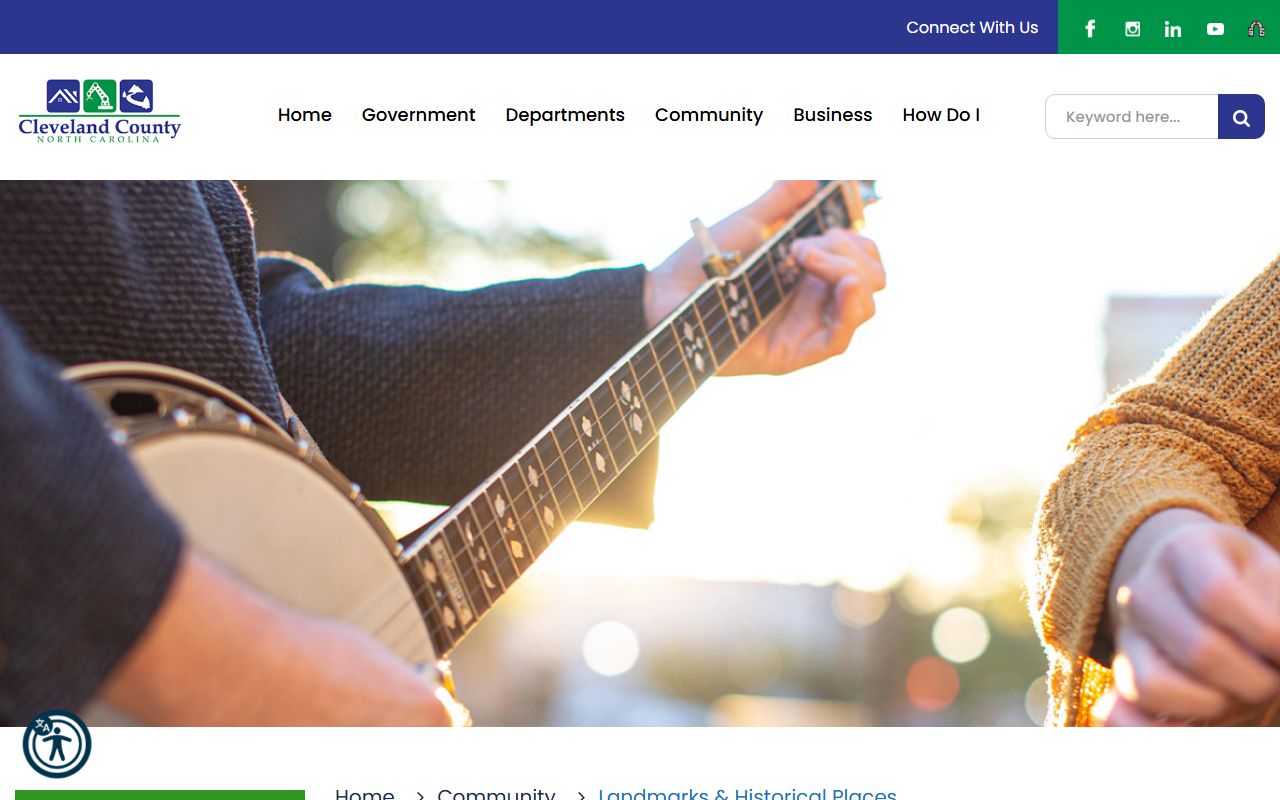
The county landmarks source is useful for separating historic courthouse references from present-day records access. The Cleveland County landmarks page lists the historic courthouse and other National Register-related places.
Cleveland County Local Record Context
Cleveland County covers 469 square miles in the foothills of the Blue Ridge Mountains. County government describes it as located between Charlotte, Asheville, and Greenville/Spartanburg. Its municipalities include Belwood, Boiling Springs, Casar, Earl, Fallston, Grover, Kings Mountain, Kingstown, Lattimore, Lawndale, Mooresboro, Patterson Springs, Polkville, Shelby, and Waco.
Local geography matters because an incident may begin with a municipal police agency, the Sheriff's Office, campus police, or a state agency, then move into Cleveland County District Court or Superior Court. A Shelby Police citation and a Sheriff arrest can both become Cleveland County court records once filed in the trial court system.
The county city and town list is the source for the local municipality names used in record routing. The Cleveland County cities and towns page helps distinguish local law-enforcement geography from the single state court filing system.
Cleveland County Superior Court Records
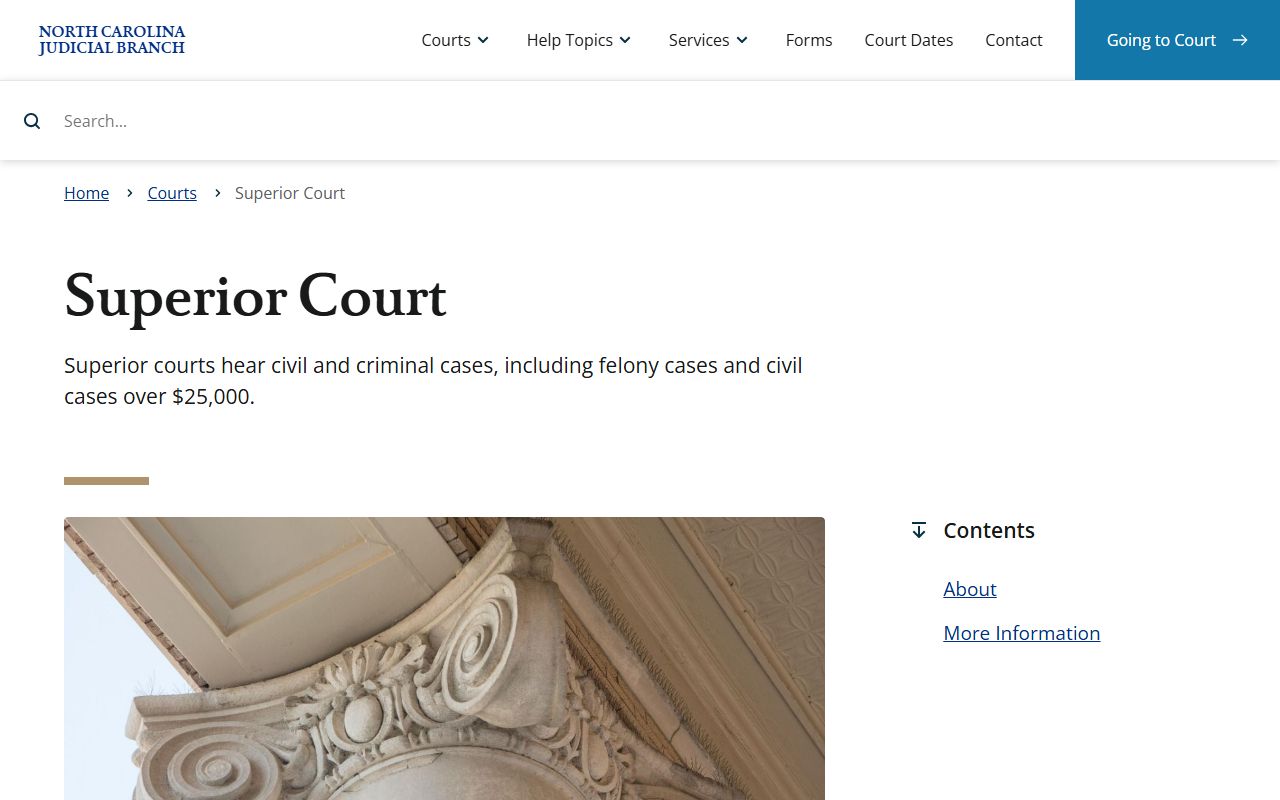
Superior Court is the general-jurisdiction trial division and handles felony trials, major civil cases assigned to that division, appeals from District Court, jury trials, and certain special proceedings. Judges rotate among districts in North Carolina, so the local court record may identify the Cleveland County court location even when a judge serves across more than one county or district assignment.
Superior Court records may include indictments, motions, orders, jury trial entries, judgments, sentencing forms, appeals from District Court, and civil filings. Some records are available through Portal or clerk terminals, while older paper files and certified copies require clerk action.
The state Superior Court overview is the source for its civil and criminal role. The North Carolina Superior Court page gives the statewide division context for Cleveland County court records.
Cleveland County Court Records FAQ
Can Cleveland County court records be searched online? Yes. Use the eCourts Portal for many public case searches, hearing searches, document views, and eligible payments. Use the clerk for full files, certified copies, older files, and background checks.
Who keeps Cleveland County court case files? The Clerk of Superior Court is the local custodian for civil, criminal, estates, special proceedings, judgments, liens, and other court files assigned to the clerk.
Are marriage records court records? Marriage licenses and certified marriage certificates are handled by the Register of Deeds. Divorce case files are court records, while divorce certificates can also be obtained through NC Vital Records.
Does Cleveland County have a separate probate court? No. The Clerk of Superior Court acts as probate judge for most estate matters in North Carolina, including Cleveland County.
Is Most Wanted the same as a warrant search? No. Sheriff P2C Most Wanted is selective and is not a complete active warrant database. Court dockets and official contacts are better warrant-status routes.
Where are traffic tickets handled? Cleveland County traffic citations generally route through District Court. Eligible citations may be paid online, by mail, or in person, but some require court appearance.