
Cleveland County Probate Court Role
North Carolina probate is handled by the Clerk of Superior Court. The Judicial Branch estates page says the elected Clerk of Superior Court in each county acts as the probate judge. Elected clerks and assistant clerks hold most estate hearings and preside over most estate cases. For Cleveland County, probate filings go through the Clerk of Superior Court at the Cleveland County Courthouse, 100 Justice Place, Shelby, NC 28150, phone (704) 476-7800.
Probate in Cleveland County includes probating a will, appointing an executor or administrator, issuing letters testamentary or letters of administration, handling year's allowance filings, managing eligible small estate or summary administration routes, reviewing estate inventories and accountings, creditor notices and claims, guardianships, and certain special proceedings tied to estate property. If a will is challenged in a caveat proceeding, the research says a Superior Court judge hears the caveat.
The official North Carolina estates page explains that the Clerk of Superior Court acts as probate judge.
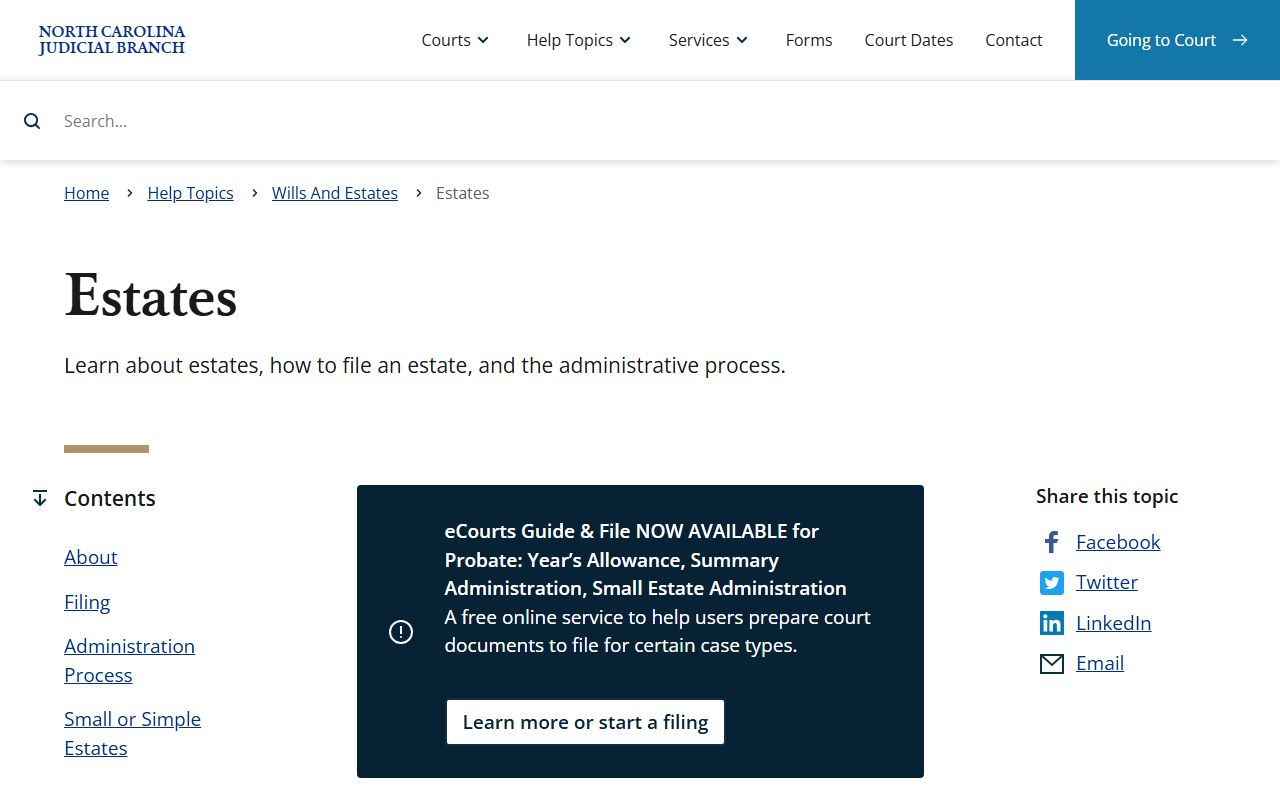
That statewide rule is the key local fact for Cleveland County because the probate venue is the clerk's office, not a separate probate court.
Cleveland County Probate Terms
Estate files use terms that are easy to confuse. These definitions follow the research glossary and the probate field inventory, with North Carolina wording kept plain.
- Testator
- The person who made a will.
- Executor
- The person named to carry out a valid will after appointment.
- Administrator
- The person appointed to administer an estate without a valid will or without an available executor.
- Intestate
- Dying without a will that controls the estate.
- Guardianship
- A court-supervised arrangement for a protected person or estate when the law requires it.
- Special proceeding
- A clerk-court category for estates, partitions, guardianships, and other statutory matters.
Search Cleveland County Probate Records
Probate search channels in Cleveland County include the NC eCourts Portal, public courthouse terminals, the clerk counter, Guide & File for preparing certain filings, and mail or copy requests for older files or certified copies. The official court-records help topic says estates and special proceedings can be accessed through public terminals, while the file itself is viewed in the clerk's office in the county where the case is located.
- Search the NC eCourts Portal for estate or special proceeding case information and filter to Cleveland County when available.
- Use the estate name, decedent name, case number, applicant name, or attorney name if known.
- Visit the public terminal at the Cleveland County Clerk of Superior Court if the online result is incomplete.
- Ask the clerk for paper-file review, certified copies, older estate files, or filings that are not visible online.
- Use eCourts Guide & File when preparing supported filings such as Year's Allowance, Summary Administration, or Small Estate Administration.
The Judicial Branch wills and estates hub collects statewide estate topics tied to probate, wills, and administration.
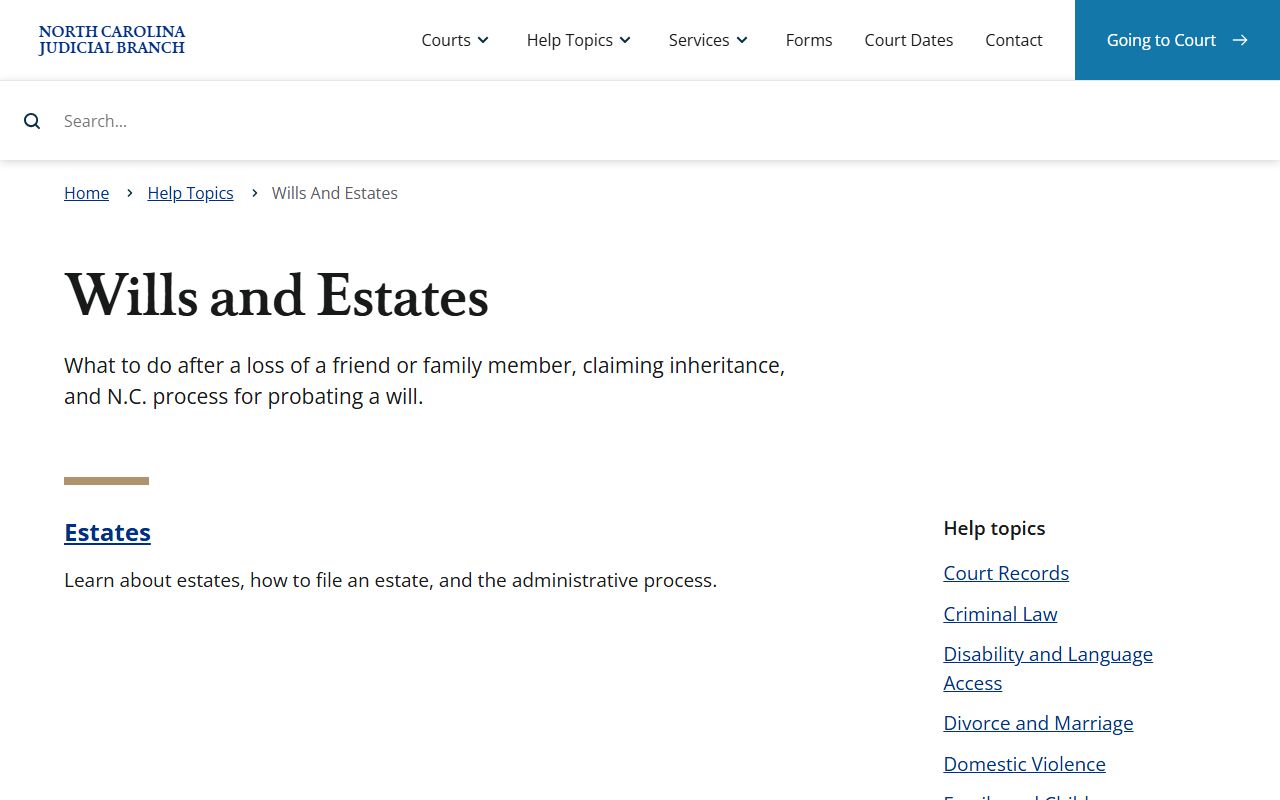
The hub helps identify the filing type before contacting the Cleveland County clerk about the local estate file.
Cleveland County Probate Contact Cards
The Clerk of Superior Court is the probate office for Cleveland County, while related federal bankruptcy records use a different court system. The Shelby bankruptcy location is housed at the Cleveland County Courthouse, but the research says that office is only staffed during court and all mail for the division should be sent to the Charlotte clerk's office.
Clerk of Superior Court
Cleveland County Courthouse
100 Justice Place
Shelby, NC 28150
(704) 476-7800
Monday-Friday, 8:30 a.m.-5:00 p.m.
U.S. Bankruptcy Court, Shelby Location
Cleveland County Courthouse
100 Justice Place
Shelby, NC 28150
Staffed only during court
Cleveland County Probate Fee Schedule
The research directs probate fee users to the official Judicial Branch Current Court Costs publication, especially the Estates Court Costs 2026 schedule. It also warns not to rely on third-party probate sites for fee amounts. Because exact estate filing and percentage fees were not captured in the research text, the safest fee schedule is a source-based schedule that identifies where each official cost must be checked.
| Probate Cost Item | Official Fee Source / Research Rule |
|---|---|
| Original estate or probate filing | Check the Judicial Branch Current Court Costs publication, Estates Court Costs 2026. |
| Letters testamentary or letters of administration | Confirm current cost with the Clerk of Superior Court or Current Court Costs. |
| Small estate / collection by affidavit | Use the official estate-cost schedule before filing. |
| Summary administration | Use the official estate-cost schedule before filing. |
| Certified copies from estate file | Confirm fee and process with the clerk at (704) 476-7800. |
| Fee relief | The probate workflow notes filing costs or fee relief if eligible. |
The Current Court Costs publication is the official fee source named for Cleveland County probate records. The Shelby bankruptcy location page identifies the federal bankruptcy location at the Cleveland County Courthouse.
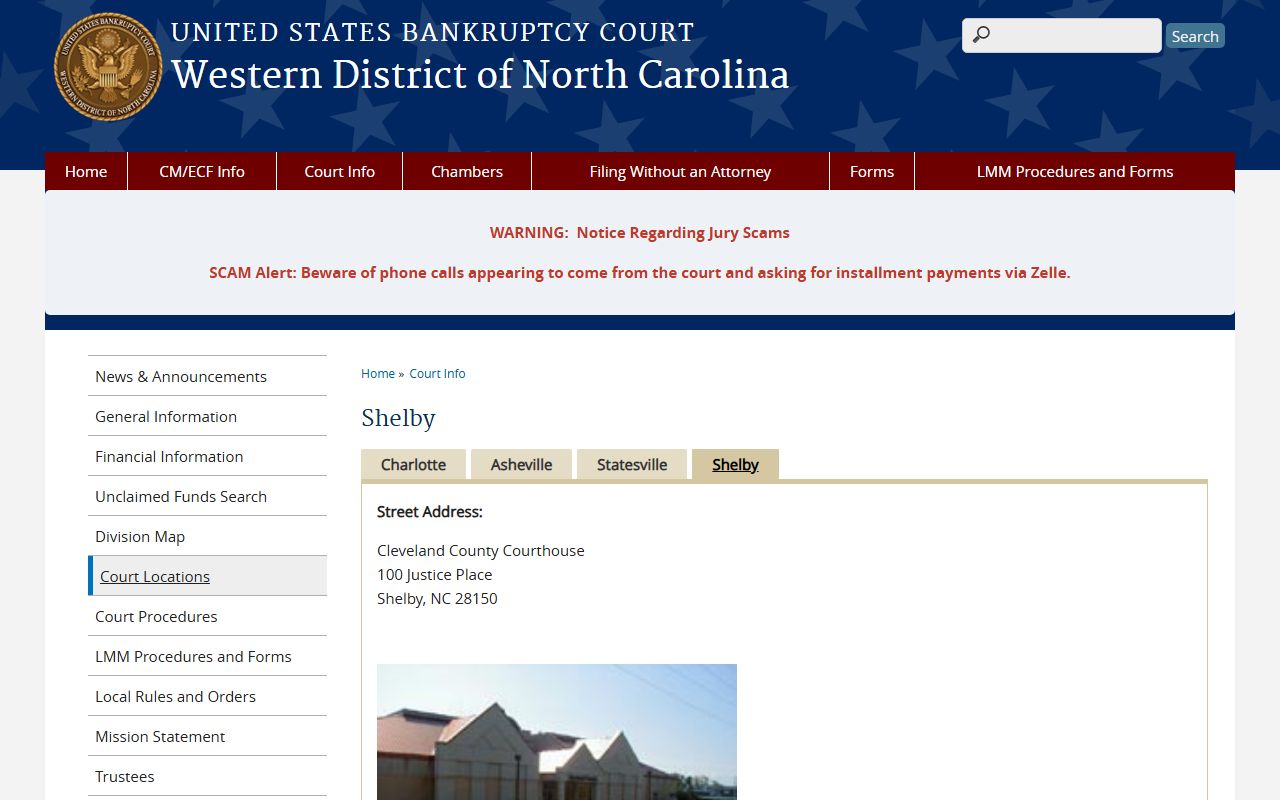
Bankruptcy is separate from probate, but the Shelby location image reinforces that some estate-related financial proceedings may be in federal court rather than the local probate file.
Cleveland County Probate Record Fields
Probate records can show more than a will. The estate file may identify the decedent, the estate number, the applicant, the fiduciary, the attorney of record, will status, notices, inventories, accountings, claims, orders, and closure. Some materials may be online, while paper files and certified copies may require clerk review.
| Field | What It Shows |
|---|---|
| Estate name | Usually the decedent's name. |
| Estate file or case number | The identifier used by the clerk and Portal. |
| Date opened | When the estate or special proceeding began. |
| Decedent date of death | The death date used for estate administration. |
| Applicant or petitioner | The person who started the probate matter. |
| Executor, administrator, collector, or fiduciary | The person authorized to act for the estate. |
| Will status | Whether a will was filed or the estate is intestate. |
| Inventory and accountings | Due dates, filed dates, and fiduciary reporting events. |
| Creditor claims | Notice and claims entries where public. |
| Orders and hearings | Clerk hearing dates, orders, and special proceeding links. |
Cleveland County Estate Filing Steps
The probate workflow begins by confirming whether the decedent lived in Cleveland County or owned property that requires local administration. The applicant then gathers the death certificate, original will if one exists, identification, asset information, heir or beneficiary names and addresses, and the required Judicial Branch forms.
After choosing the right route, such as probate of will, full administration, collection by affidavit, summary administration, or year's allowance, the applicant files with the clerk and pays costs or requests fee relief if eligible. The clerk reviews the filing, issues letters or orders if proper, and sets hearings when needed. The fiduciary then gives creditor notice, inventories property, pays valid claims and costs, files accountings, distributes remaining property, and closes the estate when the final filing is accepted.
Probate definition: In Cleveland County, probate is the clerk-supervised court process for proving wills, appointing fiduciaries, administering estates, and handling related special proceedings.
Restricted Cleveland County Probate Records
Estate files are often public, but not every probate-related document is fully open. The research notes that confidential information, minor or guardian information, medical details, account numbers, and sealed filings may be restricted or redacted. Guardianship records can be more sensitive when protected-person information is involved.
Public access rests mainly on G.S. 7A-109 for clerk-maintained court files, unless another law blocks access. A user who cannot see a probate entry online should not assume the file is unavailable. The clerk may need to check paper records, restricted materials, older files, or a sealed portion of the case. For family records tied to divorce rather than estates, Cleveland County marriage and divorce records use different offices and request channels.
The U.S. Bankruptcy Court for the Western District of North Carolina is a separate federal court system, not the Cleveland County probate custodian.
The distinction is useful when an estate search reveals bankruptcy issues, because those records are searched through federal bankruptcy systems instead of the county probate file.